You Got Him for the Walks. Now Your Shoulder Braces at the Door.
Why a strong dog pulls, what the leash has been teaching him, and a free five-day method you can start on your next walk.
By the Trueline team · 4 min read

The squirrel is fifteen feet away and he saw it before you did. The leash snaps tight, the loop bites into your palm, your shoulder takes the jolt, and you dig in your heels until it passes. Then comes the next driveway, and it happens again.
You got him for the walks you pictured. The loose leash. The easy trot. Coffee in one hand. His tags jingling beside your leg. The two of you on the same side of the sidewalk. Now your shoulder starts bracing before he even reaches the door.
If that is your walk, nothing is wrong with you or with him. The leash has been teaching him the wrong lesson, and you can reteach it this week.
Somewhere around week three, a lot of people with a strong dog stop believing it will change. Big dog, strong dog, stubborn dog. So the walks get shorter. Or they happen at 6 a.m. when nobody is around. Or the walk becomes two laps of the backyard, because the backyard has no squirrels.
It does not have to go that way. There is a reason he pulls, a free method you can test this week, and one piece of equipment that makes the method work faster. Start with the reason.
Every step forward makes him pull harder
Dogs lean into pressure. Pull on a dog and he pulls back. That is why sled dogs pull so well, and why a leash clipped at the back so often turns a walk into a tug-of-war.
The ring sits between his shoulder blades, in line with the direction he is already going. Every stride tightens the leash. The tighter it gets, the harder he leans. The harder he leans, the tighter it gets. That loop is how a 62-pound dog ends up towing a grown adult down the block.
Do not take our word for it. On your next walk, hold the leash tight for one second and watch what he does. See whether he leans into it.
What you have probably tried already
A shorter leash. A thicker leash. Gloves. A bigger harness. Treats, which work well while he is calm and do nothing the moment the squirrel shows up. Every one of those changes how the pull feels in your hand. None of them changes where the pull goes.
Move the clip and the pull has nowhere to go
A front-clip harness puts the leash ring at the center of his chest. When he pulls ahead, the leash no longer runs straight back. It angles to the side and swings his shoulders around toward you. Charging ahead stops working, because the harder he goes, the more he turns to face you.
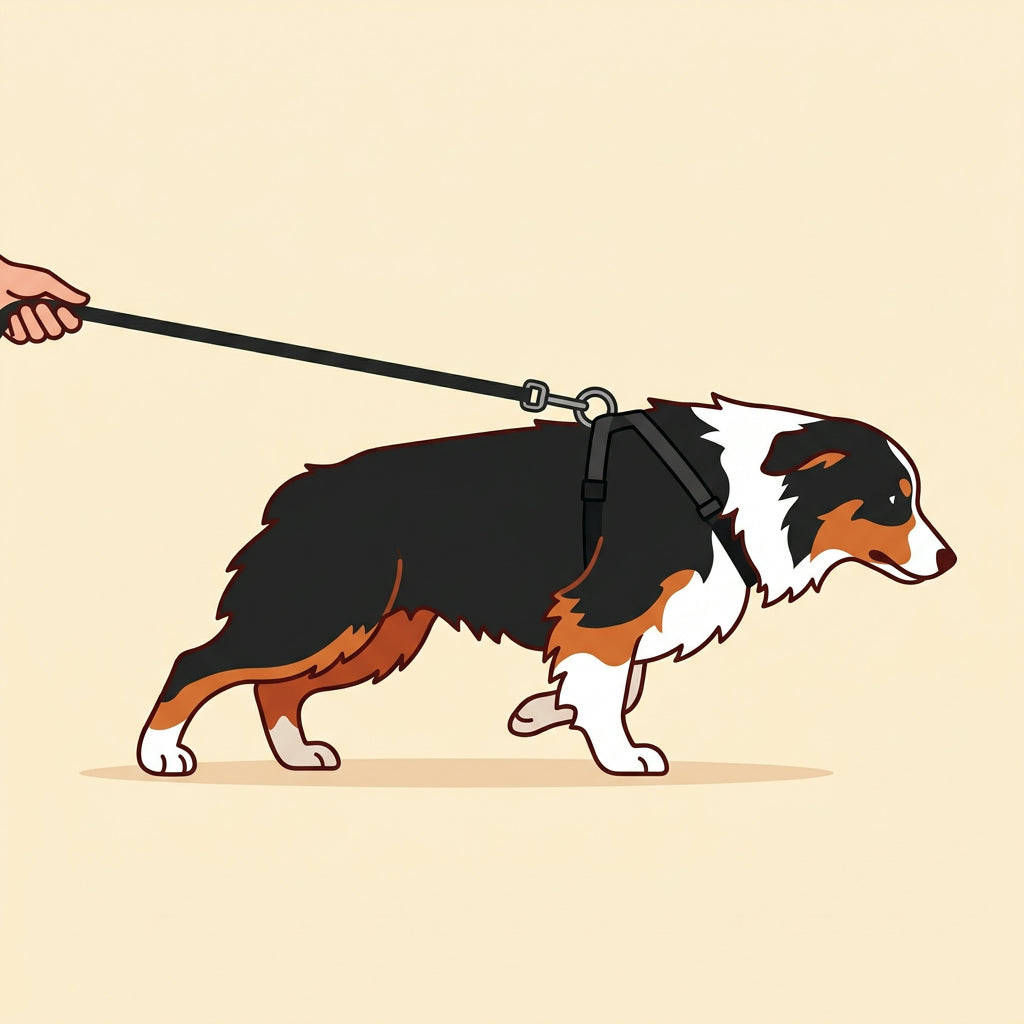
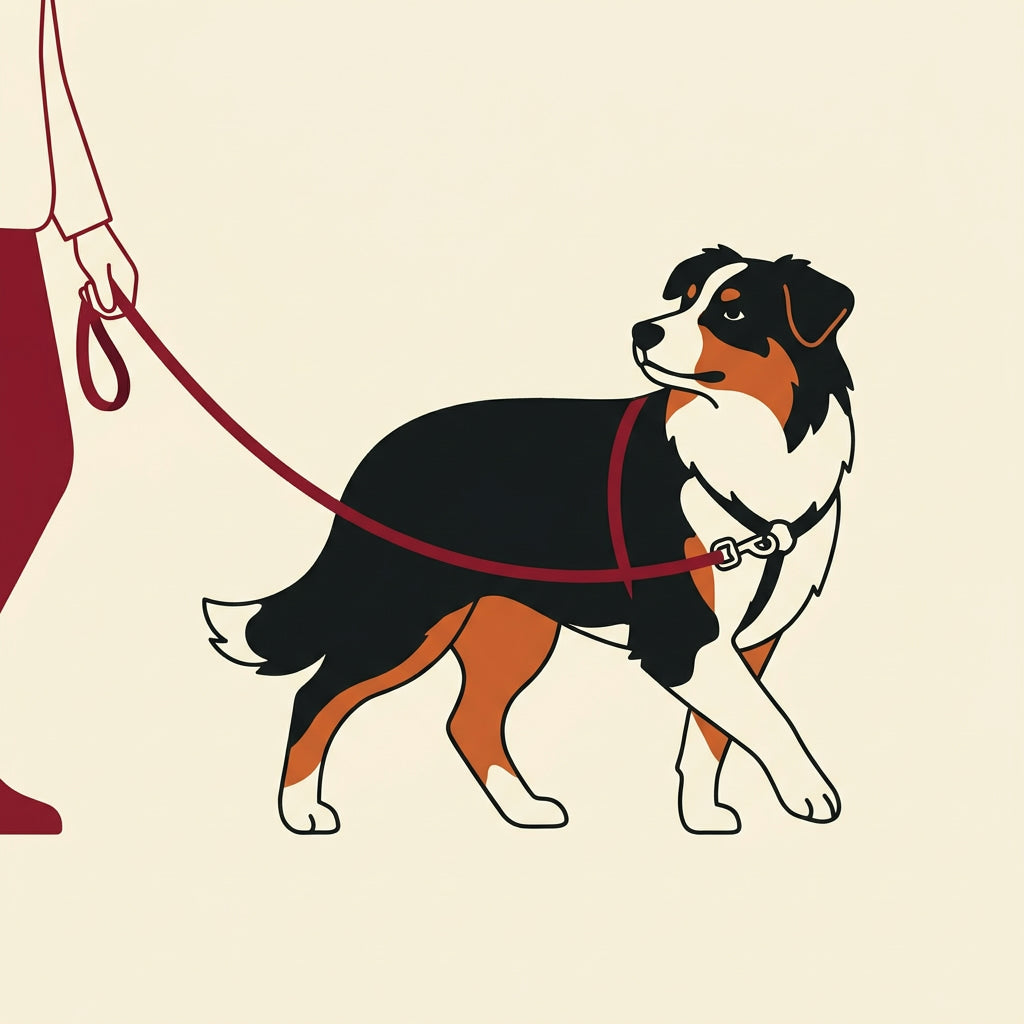
A front clip does not train a dog. It removes the thing that was training him to pull.
The free fix: five days, ten minutes a day
This works with any harness you already own. Pick the quietest place you have, like the driveway, the backyard or the hallway, and take a pocket of small soft treats.
- Pick a reward spot. Choose a side, left or right, and deliver treats only there, at his nose height, every few steps while the leash is loose. He learns where the good stuff happens.
- Go still the second it tightens. Plant your feet. No yanking, no scolding. A tight leash means nothing moves, so pulling stops paying.
- Pay for slack. The moment he turns back or the leash drops into a loose curve, say yes, give a treat and walk on. Forward motion is his paycheck.
- Change direction when he pulls ahead. Turn calmly and walk the other way. He learns to keep one eye on you.
- Raise the difficulty slowly. Days one and two in the quiet spot. Days three and four on your street at an off-peak hour. Day five, add a mild distraction. Whenever he cannot think, go back a step.
That is the whole method, and it costs nothing. It also has one weak point: every time the leash clips at his back and tightens, the old reflex gets a free rep. Which is where equipment matters.
Why the harness decides how fast this works
Training teaches him what to do. The clip decides what happens in the half second before he remembers. On a back clip, a hard pull still gets a straight line to lean into, so the old habit keeps winning practice. On a front clip, the hard pull turns him toward you, so the loose-leash reps you are rewarding happen more often than the pulling ones.
What the walk looks like on the other side
Picture a Tuesday morning. The door opens, you clip the leash to the ring on his chest, and you pick up your coffee with the other hand. The leash hangs in a loose curve and his tags jingle beside your leg.
Two houses down, the squirrel is back. He still sees it. He still gets excited. But the pull turns him toward you, you say his name, and the walk keeps going. You do not stop. You do not dig in.
Your arm hangs at your side instead of stretching out in front of you like a tow rope. By the end of the block you notice your shoulder is not tight. The street you used to skip because of the neighbor's dog is back on the route. You walk as far as you want to, not as far as your shoulder allows.

If nothing changes
Walk him twice a day and that is about 730 walks a year, each one starting with the same brace at the door. Your shoulder takes the jolt every time he hits the end of the leash. When your arm hurts, walks get shorter, and a strong dog with extra energy does not get calmer. He just gets more practice at the one thing that works for him: pulling.
This is not rare. A study of US emergency rooms counted about 32,300 adults hurt while walking a leashed dog in 2020, up from about 7,300 in 2001. Fractures, sprains and head injuries were among the most common. The study does not say how each fall happened, and no harness can promise to prevent one. What a front clip can do is turn the pull sideways, toward you, so the leash is not a straight line he can lean into.
Source: Maxson et al., Medicine and Science in Sports and Exercise, 2023, using emergency room data from 2001 to 2020.
Now picture the other Tuesday. Same door. Same porch step. Same shoulder. Same quiet guilt when he looks back at you with his tongue out and you are already tired.
The leash will not loosen on its own, and walks are the best part of his day. Every week it stays this way is another week of 6 a.m. walks and backyard laps.
Start the five days tonight. If you want the clip that makes them faster, it is below, with 30 days to see if it changes your walk.
See the Trueline harness30-day guarantee. Free shipping on every order.
What is in the Trueline harness
- Front chest clip. Turns a hard pull sideways instead of letting it run up the leash.
- Padded mesh across the chest and belly. Soft where the harness sits, so a long walk does not rub.
- Four adjustment points. The fit follows his shape and stays seated instead of riding up or twisting.
- Quick-release buckle. On in one press, even when he is bouncing at the door.
- Reinforced nylon webbing. Built for the hard lunges, machine washable for the muddy ones.
Sizes S, M and L, in red, black or orange, with a chest-girth chart on the product page.
Getting the fit right
- Measure before you order. Chest girth at the widest point, just behind the front legs. Between sizes, go up. The straps adjust.
- Fit it at home first. You should be able to slide two fingers under the straps. Let him wear it for ten minutes with treats before the first walk.
- Clip to the front ring and keep a little slack. A tight leash from the first step feeds the old habit.
Try it for 30 days. If the fit is wrong, we ship the right size free.
Walk him on it for 30 days. Wrong size? Send us a photo within 30 days of delivery. We ship the right size free, and you keep the first one.
Shipping, plainly
Orders are processed within 2–4 business days and ship with tracking. Most orders arrive in about 2 weeks from the order date, and some take up to 4 weeks depending on location. Free shipping on every order.
Questions people ask first
My dog is really strong. Will a front clip hold?
The webbing is reinforced where the pull lands. A front clip does not fight his strength. It turns it sideways.
Will it stop the pulling completely?
It takes away the straight line he was leaning into, which for most dogs changes the walk quickly. It works best alongside the five-day method above. If your walks do not change, the 30-day guarantee covers you.
Which size should I order?
Measure his chest girth just behind the front legs and match it to the size chart on the product page. If he is between sizes, go up and use the four adjustment points to dial it in.
Is it comfortable for long walks?
Padded mesh covers the chest and belly. Four straps adjust so nothing digs in or slides.
What if it does not fit?
Contact us within 30 days of delivery and we ship the right size free, and you keep the first one.

Free shipping on every order.