When Your Dog Lunges: Why It Happens and What to Do in the Next Ten Seconds
Where a lunge sends its force, a free five-step plan for your next walk, and one gear change that helps keep your feet under you while he learns.
By the Trueline team · 4 min read

You used to walk every street in this neighborhood.
If you have started checking the window first, you are not paranoid. You are prepared, and that is the right instinct. This page gives you what to do in the next ten seconds and how to take the street back over the next few weeks.
Another dog turns the corner half a block ahead. You see it about half a second after he does. His weight shifts, the leash snaps tight, and for a moment you are not sure your feet are going to hold.
Then it passes. Your heart is pounding and your wrist aches, and you start planning around the next one. The walk at 6 a.m. The long way around the block. The street you quietly stopped using.
If that is your walk, this page is for you. It covers why it happens, what to do in the moment, and the one piece of equipment that changes where the force goes.
A lunge goes wherever the clip sends it
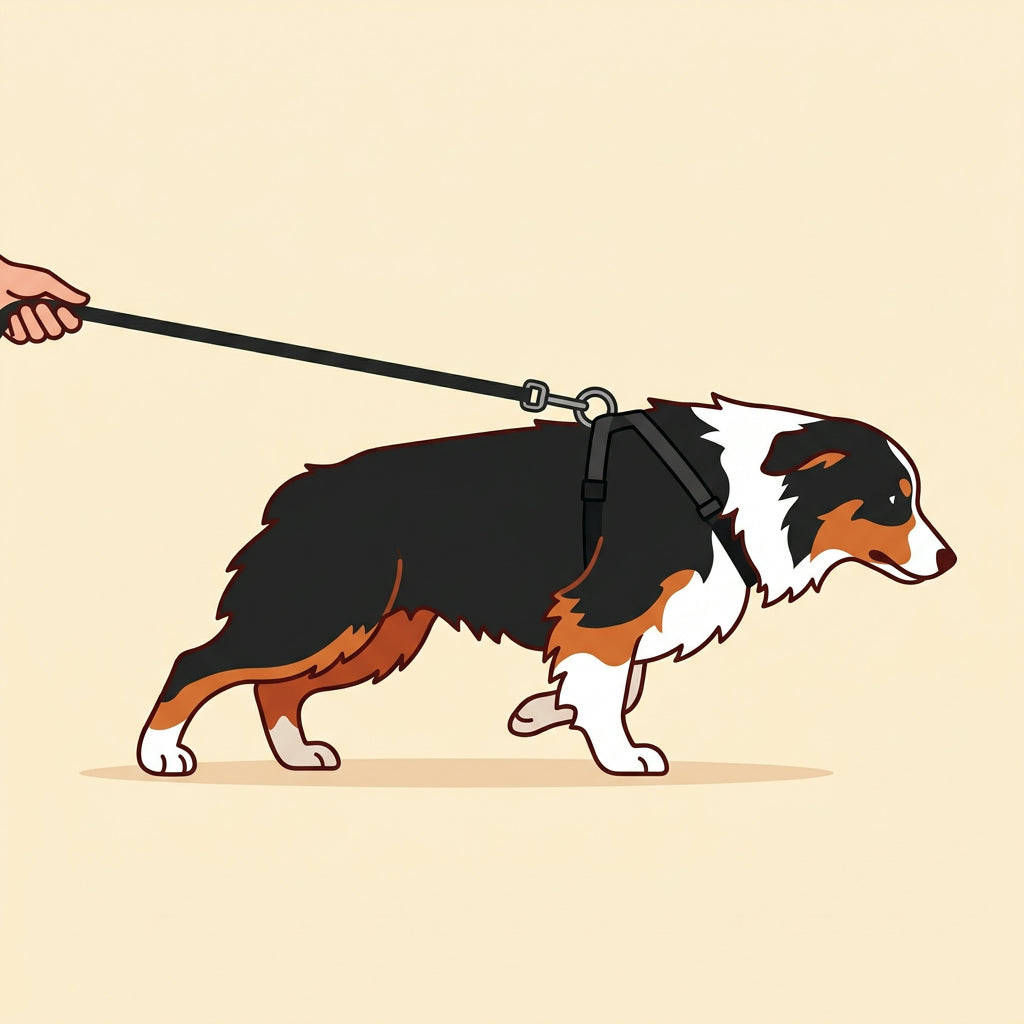
A lunge is a burst of forward force, and it has to go somewhere. On a back-clip harness the leash attaches between his shoulder blades, in line with the direction he is already moving. The lunge gets a straight line, and that line ends at your arm and your footing.
A bigger dog, a faster dog or a sudden dog does not change the geometry. It only changes how much force comes down the line.
Clip it at the chest and the force turns
A front-clip harness attaches the leash at the center of his chest. Now the same lunge pulls against the front of his body. It swings his shoulders around toward you instead of towing you toward whatever he sees.
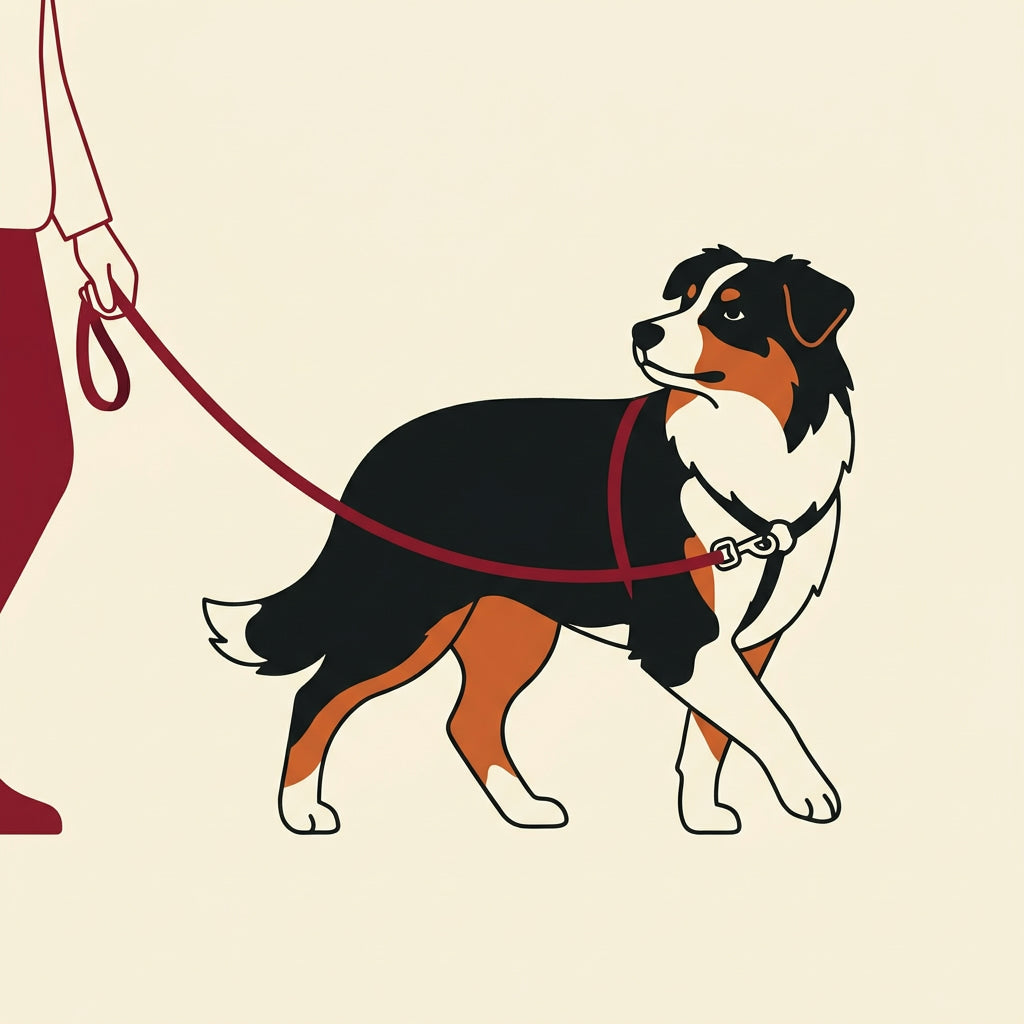
A front clip will not stop him from reacting. That takes training, and a good trainer is worth the money. It changes what the lunge does to you while the training catches up.
The free plan: five steps for the next encounter
The harness handles where the force goes. These handle the rest, and they are moves you can test for yourself on your next walk. They work with any gear, so you can try them before you buy anything.
- Find his limit. That is how close another dog can get while he still takes a treat. Stay back at least that far. Closer is where the lunge starts.
- Make distance early. Spot the other dog before he does and cross the street or step into a driveway while he is still calm.
- Feed before the reaction, not after. Treats at first sight of another dog teach him that other dogs predict good things.
- Turn away smoothly. A calm U-turn gives him somewhere to go. Standing and staring gives the moment room to grow.
- Feet under you, leash in both hands. Never wrap the leash around your hand or wrist. A front clip keeps the pull turning him, and your stance does the rest.
Do this for a few weeks and his limit shrinks, so other dogs can get closer before he reacts. That is the real progress marker, not a quiet walk on day one.
What the walk looks like on the other side
Picture it. The corner dog appears half a block ahead, ears up. He still reacts. But when he lunges, the leash turns him toward you and your feet stay under you. You shorten the leash, step into the nearest driveway and feed him as he settles. The other dog walks past, and your hands are steady by the time you reach the stop sign.
The moment is smaller, and it is over sooner.
A week later you notice you walked the street you had been avoiding. You wave at a neighbor you had not seen since spring. You did not need to be stronger or faster. You needed the force to go somewhere other than into you.

If nothing changes
Right now the walk is planned around the fear. The early hour, the long way around, the quick look out the window before you open the door. None of that makes the next dog go away. It only moves the moment to a different corner, and it makes the walks you both love smaller.
This is not rare. A study of US emergency rooms counted about 32,300 adults hurt while walking a leashed dog in 2020, up from about 7,300 in 2001. Among the people hurt, adults 65 and older had about twice the odds of a broken bone, and women about one and a half times the odds. The study does not say how each fall happened, and no harness can promise you will not fall. What a front clip can do is send a sudden lunge sideways instead of straight down the leash into your arm.
Source: Maxson et al., Medicine and Science in Sports and Exercise, 2023, using emergency room data from 2001 to 2020.
Tomorrow morning you will feel the leash go quiet. Then stiff. You will see the other dog before he does, and your stomach will drop the way it did last time.
You can meet that moment the same way, wrist burning and feet sliding. Or you can meet it with a plan, feet under you and the force turned sideways. Every week it stays the same is another week of the early walk and the long way around the block.
Start with the free steps tonight. If you want the clip that turns his lunge, it is below, with 30 days to find out.
See the Trueline harness30-day guarantee. Free shipping on every order.
Built for a hard lunge
- Reinforced nylon webbing at the stress points, made for a sudden hard pull.
- Four adjustment points so it stays seated and does not twist mid-reaction.
- Front chest clip that turns the lunge sideways instead of down the leash.
- Quick-release buckle. On in one press, no wrestling it over his head.
- Padded mesh and machine-washable webbing for the daily walk and the muddy one.
Sizes S, M and L, in red, black or orange, with a chest-girth chart on the product page.
Try it for 30 days. If the fit is wrong, we ship the right size free.
Walk him on it for 30 days. Wrong size? Send us a photo within 30 days of delivery. We ship the right size free, and you keep the first one.
Shipping, plainly
Orders are processed within 2–4 business days and ship with tracking. Most orders arrive in about 2 weeks from the order date, and some take up to 4 weeks depending on location. Free shipping on every order.
Questions people ask first
Will it stop him from lunging?
No harness stops a reaction. Lunging at other dogs is a training question. What this harness changes is where the force of a lunge goes, so it turns him toward you instead of towing you forward.
Is it strong enough for a hard lunge?
The webbing is reinforced where the pull lands. Four adjustment points keep it in place so it does not twist or ride up.
Which size should I order?
Measure his chest girth just behind the front legs and match it to the size chart on the product page. If he is between sizes, go up and use the four adjustment points to dial it in.
How do I get it on a dog who gets worked up?
The buckle opens and closes in one press, so you can fit it at the door without wrestling a strap over his head.
What if it does not fit?
Contact us within 30 days of delivery and we ship the right size free, and you keep the first one.

Free shipping on every order.